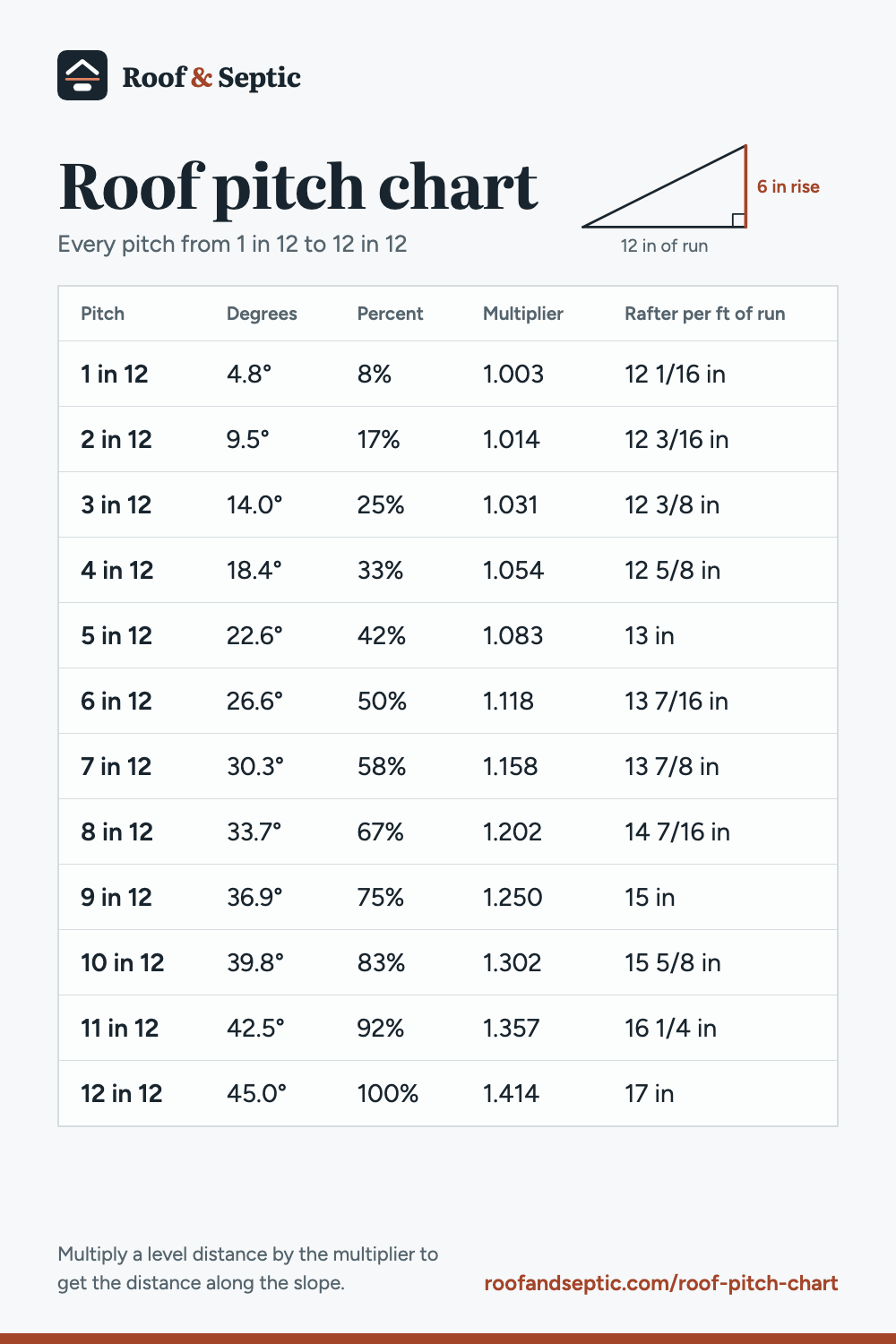
Roof pitch chart, with degrees and multipliers
Roof pitch chart · Roof & Septic · roofandseptic.com/roof-pitch-chart
Every pitch from 1 in 12 to 12 in 12.
| Pitch | Degrees | Percent | Multiplier | Rafter per ft of run |
|---|---|---|---|---|
| 1 in 12 | 4.8° | 8% | 1.003 | 12 1/16 in |
| 2 in 12 | 9.5° | 17% | 1.014 | 12 3/16 in |
| 3 in 12 | 14.0° | 25% | 1.031 | 12 3/8 in |
| 4 in 12 | 18.4° | 33% | 1.054 | 12 5/8 in |
| 5 in 12 | 22.6° | 42% | 1.083 | 13 in |
| 6 in 12 | 26.6° | 50% | 1.118 | 13 7/16 in |
| 7 in 12 | 30.3° | 58% | 1.158 | 13 7/8 in |
| 8 in 12 | 33.7° | 67% | 1.202 | 14 7/16 in |
| 9 in 12 | 36.9° | 75% | 1.250 | 15 in |
| 10 in 12 | 39.8° | 83% | 1.302 | 15 5/8 in |
| 11 in 12 | 42.5° | 92% | 1.357 | 16 1/4 in |
| 12 in 12 | 45.0° | 100% | 1.414 | 17 in |
On a phone, slide the table sideways. The pitch column stays in place.
What the multiplier is for
The multiplier turns a flat measurement into a length along the roof. Multiply a level distance by it and you get the distance along the slope.
Multiply the footprint under a roof by it and you get the area of the roof surface, before overhang and waste.
How to read a pitch
A pitch such as 6 in 12 says the roof rises 6 inches for every 12 inches it runs level. The first number is the rise. The second is always 12.
Look along a row of the chart for the same slope in other terms: the angle, the percent, the multiplier, and how much rafter each foot of run needs.
The chart as a picture
Common questions
Is a bigger number a steeper roof?
Yes. 12 in 12 rises as much as it runs, which is 45 degrees. 1 in 12 is nearly flat.
How do I find my own pitch?
Hold a level against the roof and measure down at the 12 in mark, or use an angle finder. The roof pitch calculator does the sums.
Why does the rafter column say "per ft of run"?
It is the length of rafter along the slope for every 1 ft of level distance. Multiply it by the run in feet, then add the tail.
Related
Last reviewed 18 November 2026 · How we calculate · Report a wrong answer